Service dog assessment

A lot of people get puppies to become service dogs, but I’m a big fan of taking an adult rescue and turning them into service dogs. Their personalities are already formed, so you know what you’re getting. They’re through the ages when they’re easily traumatized and things can go wrong, so you don’t have to worry about pouring a bunch of work into them only for things to go sideways and it all be for nothing. (I mean, you have a great pet, but possibly not a service dog.) And you’re through the puppy energy, so you’re not contending with a dog that’s bouncing all over. I love it.
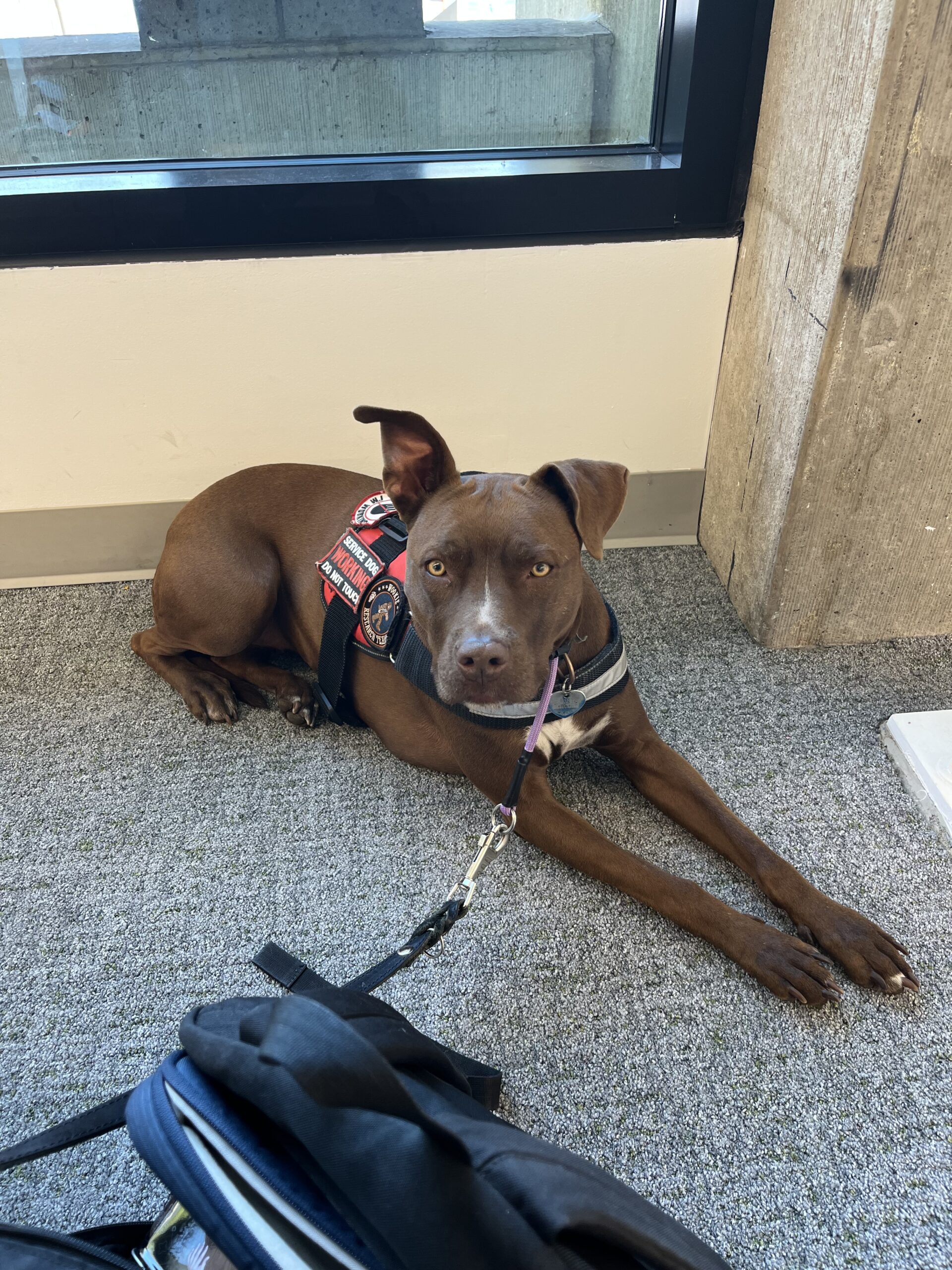
So today I’m testing out a dog whose owners are needing to rehome her (due to their health issues, not anything wrong with her). As it happens, I have a friend who’s looking for a service dog. I spent a few weeks taking this dog to the dog park, just to help burn off some energy as a favor to her owners, and got to know her a little bit. Enough to say, “Hey, she might make a pretty good service dog.”
There are a lot of ways to test out a service dog. With puppies you can actually find “how to” videos on YouTube, and go through the test items. But they’re only so helpful, in my opinion, when dealing with an adult dog since the adult dogs have their own history and feelings on things.
My favorite way to test out a possible service dog is to run them through the gauntlet. Put them in situations that would be normal. So, first, we went for a walk through downtown Salem. I’m looking for a place where there will be people, noises, kids, cars, bikes, walkers, strollers–anything and everything you might see while out in the world. If the dog reacts to something, I’m going to keep in mind how much of a reaction it is (is it something we can train out of them with practice and exposure?), and whether the dog reacts out of fear, stress, aggression, or play. WHY the dog is reacting is as important as how big the reaction is.
Next, we go somewhere where I sit for an hour or more and work. I’m testing the dog’s ability to settle down and chill. I’m not expecting them to be good at it; I expect that I’ll spend the first twenty minutes teaching them how to lay down and settle. At every step I assume the dog doesn’t know anything about what I’m asking–part of the testing is to see how quickly they learn, how quickly they learn under stress and distraction, and what their baseline response is to new situations and heavy distraction. Even still, after twenty minutes most dogs have the idea and, if they’re able, they’re willing to settle down. They might get up occasionally, inch away to sniff, get bored and whine, all sorts of things that I would consider trainable. As long as they mostly stay down, I know they have the right energy level to be able to learn to settle and chill for a long time. (Note that I stay and work for at least an hour; longer is better. I want to simulate that “long time” that someone take to read a book, sit and work, sit through school, etc.)
Finally, I take them to a store (Lowe’s is my favorite). We get around things on shelves and loud carts to see how tempted they are to grab things, and to see what response they have to loud, new noises and weird things like carts following them around.
By the end of three or four hours, I have a pretty good idea of a dog’s temperament, what their strengths and weaknesses are, what we’ll need to work on extra, and whether they’d be happy being a service dog.
A big part of all of this is watching their body language. Knowing why they’re doing what they’re doing, whether they’re happy or unhappy, what stresses them, and so on. Have I mentioned lately that knowing a dog’s body language is crucial?
If you’re thinking of getting a service dog, or have a dog and you’re wondering if they could be a service dog, reach out. I can help you get there.
Jenna